
by John T. Biggs
Our family junk business barely interested local cops. If they bothered checking our place for stolen merchandise at all, they always came after lunch. That meant we stayed busiest in the morning hours.
“Theft is a necessary evil,” Dad told me. Turning philosophical gave him something to occupy his mind while we hid aluminum siding and copper tubing in the metals shed. Tension that came hand in hand with criminal enterprise was hard on both of us. So, when noon rolled around, we relaxed in our shabby little office and waited for the more forthright scrap iron customers to arrive.
Dad couldn’t seem to shake off his nerves. It was just the two of us, but he kept his voice low. “Found out something yesterday.” He paced around the cluttered space, stepping over spare auto parts we’d probably never sell.
“Something bad,” he said. “Real bad, I guess.” Dad kept pacing but didn’t say anything more for so long it seemed like he was done.
Finally, he blurted out, “Candyman Greenwade killed a man in a Jackson County whorehouse. Didn’t know it when I hired him.”
Our key employee was a murderer. That was bad enough, but his face told me worse news was on the way.
“Happened in ’54, three years ago. He killed a white man, Jimmy.”
Usually, folks would shake their heads over a whorehouse murder, call it a shame, write it off as a had-it-coming sort of thing. But a black-on-white killing put a different spin on things. We lived in a relatively easy-going part of Arkansas, but things had gotten tense since President Eisenhower integrated Little Rock’s Central High School.
“I don’t know what to do except wait and see what happens,” Dad said. “Maybe nothing will.”
But something was bound to happen sooner or later, no matter how much we didn’t want it to. Candyman Greenwade was the most likable employee we’d ever had—quick to smile and slow to anger, and a regular diplomat with Black customers. Disagreements were rare in the junk business, but when one happened, Candyman was our go-to man.
“He’s fixing things now with a couple of boys from this morning who think my scales weighed light.” Dad looked embarrassed about the word boy but didn’t correct himself.
“Did you weigh them light?” I asked.
“Well… that stuff will have to cool down a while before I sell it.” Philosophical again.
We watched through a dirty office window as Candyman escorted three Black customers to the metals scale. He whistled a tune full of warbles and register changes.
“Hard to believe a man can do that with his lips,” Dad said. “Sounds like a flute.”
“A magic flute,” I said. “The kind snake charmers use.”
Candyman walked the customers around the scale. They tipped the balance beam, took turns weighing each other, and before long they shook their heads, wondering what had bothered them.
“Mr. Greenwade is a good man,” Dad told me. The Mr. part was new. Still hard for him to say.
Candyman and I sorted copper wire according to diameter. He seemed open to my questions. “Dad said you might have killed a man.” I ran a magnet over the tangle of wire to make sure it hid no iron. “Is that true?”
He whistled instead of answering, but I was too curious to be hypnotized.
“They say it was in a whorehouse,” I said. “You worked there?”
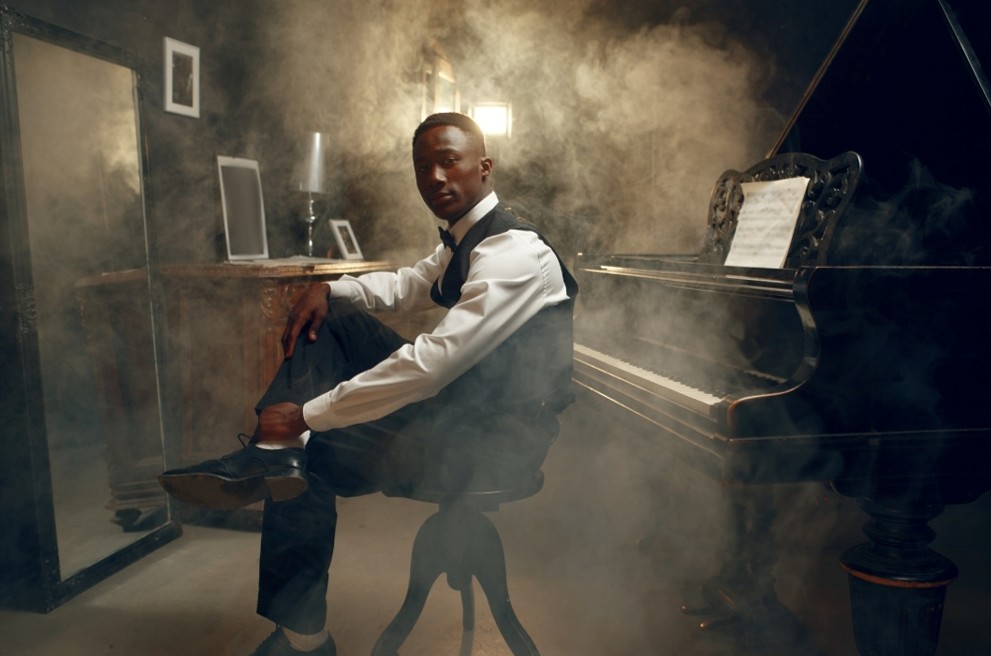
Candyman nodded. “Played the piano at the Cherry Patch in Jackson County. They called me the professor. Every whorehouse piano man was the professor.” He whistled licks from songs I’d never heard and talked about the great blues men who came to hear him play. “Jay McShann came from Kansas City, Roosevelt Sykes from Little Rock, and my all-time favorite, Blues Boy King all the way from Memphis, Tennessee.”
I nodded like I recognized the names.
“Good music and pretty women is mostly what men want from this world.” Candyman stood, dusted his hands on his pant legs, and told me to put the sorted copper in the metals house. “Got a radiator to drain right now.” He winked so I’d know he really had to pee.
The only piano I ever saw brought to the junkyard was strapped in the bed of a bright red Chevy pickup truck with a Jackson County tag. The sellers were two Black men with hard eyes. They crossed their arms and looked dissatisfied with the money Dad had paid them. They watched him push a ramp against the pickup bed.
“I’ll need a little help to slide it down,” he said. “Don’t know where my man got off to.”
I made excuses for Candyman, but Dad shushed me with a look.
“I could give one of you fellows a dollar more if you’d lend a hand,” he said. That was an hour’s wage. It wouldn’t take five minutes to slide that piano onto the ground, but those men didn’t move.
One was taller than the other, with lighter skin and straighter hair. He did most of the talking. “You got this piano real cheap, man. It plays good.” He reached over the side of the pickup bed and ran his fingers over an octave’s worth of keys. “Finish is scratched, but the insides is fine.” He looked at me and then at Dad like he was figuring out how much trouble we could cause if he drove off now that he’d been paid. Maybe sell the piano twice.
“Ain’t many musicians shop for instruments at a junkyard,” Dad told him. “I’ll bust it up for the cast iron frame inside. Almost more trouble than it’s worth.” He climbed into the bed and leaned against the piano like he had nothing else to do. “Guess I could do that right on the truck. Fetch a sledgehammer, Jimmy.”
The tall man shoved his partner toward Dad. “Climb on up there. Give the man a hand.”
The shorter man spit on the ground and crossed his arms tighter, but another shove got him into the truck bed. He held out his hand, “You said a dollar.”
Dad reached into his pocket and pulled out four quarters like he’d been expecting this to happen. Once the piano was on the ground, he inspected it more closely, probably wondering if somebody might take it in trade for a cracked engine block or a box of brass fittings.
As soon as the red pickup pulled away, Candyman stepped out of the metals house. “Sorry to disappear like that.”
“You recognize those boys?” Dad asked. “From back in your Cherry Patch days?”
“I know the truck, and I sure recognize this piano.” He pulled back the wooden panel and made a harp sound with the strings.
“Probably a good thing they didn’t see you.” Dad looked like he had questions but went back to the office instead of asking them.
Candyman danced his fingers across the piano keys, creating music out of pure energy. He played sharps that cut into my brain and flats that hit me like a slap. After a few minutes, he started telling a story. “Men used the Cherry Patch to forget about the world.” No singing to it, but his words blended with the music. “Girls is one way to do that; blues is another. Both leave you satisfied but wanting more of the same.”
I don’t know how long he played; time disappeared. I couldn’t think one second forward or remember one second back. Could hardly tell when the music trickled down to nothing. Candyman pecked at a few keys on the bass side and turned his head the way a dog does when it hears unnatural sounds. He hit the lowest white key, stepped on a pedal, and then reached his hand inside the piano case and pulled out a knife.
The blade was a reddish-brown color with silver shining through in places. It had a double edge with a point exactly in the middle.
“Looks rusty,” I said.
Candyman spat on the blade. Wiped it on his shirt until the whole thing was bright silver. “Ain’t rust.” He lifted his left pant leg and slid the blade into an ankle sheath, waiting there for it like an empty parking place.
“Can you play that song again?” I asked.
“Something like it, maybe.” He dragged a wooden box to the piano and sat on it like a bench.
The last song had made me forget everything; this one made me remember things that never happened. Like kissing girls I hardly knew. Like doing important things—it didn’t matter what. Love and pride, and satisfaction rolled into eight bars of music.
“The Cherry Patch professor keeps things calm.” Candyman talked between the notes. “Girls heat the customers up, and the music keeps them from catching fire.” He shifted his fingers over the keys the way Dad slid weights on the scale. “The professor builds songs to fit conditions,” Candyman said. “Conditions always change so the tunes are always different.”
The music stopped while he considered his memories. “Except for ‘Ruby’s Song.’ It always came out the same.” He placed his fingers on the keys, but Dad interrupted.
“Those Cherry Patch boys are back,” he said. “Must be having second thoughts. Can you straighten them out, Candy, or should I call the Sheriff?”
Dad wouldn’t bring the police unless things turned serious. There’d be questions. They’d want to look around. Trouble for Dad. Trouble for his customers. Trouble for an employee who might have killed someone a few years back.
Candyman headed toward the truck as it pulled into the American Iron and Metal Works parking lot. He wasn’t whistling this time, and he walked a little differently. Maybe it was something the music left inside him, or maybe it was the weight of the knife over his ankle.
The taller man climbed out of the truck, shouting about the cheating white man who stole his piano. Candyman didn’t waste time arguing. He broke the tall man’s nose with a left hook, took hold of his throat, and bent him backward over the truck fender.
The shorter man scrambled out holding a revolver.
Candyman let go of the tall man long enough to swat the pistol out of the short one’s hand. He punched him in the chest and watched him go down on his knees.
“Get your asses back in that truck,” he said. “Don’t come back here no more.” He turned and walked away completely certain he would be obeyed.
Candyman didn’t go back to work after chasing the Jackson County men away. He sat down at the piano and filled the junkyard with music.
Dad didn’t complain. “Go and listen,” he said. “A young man can learn a lot from the blues.” For the rest of the day, I sat on the ground beside the Cherry Patch piano and listened.
Candyman told his story as he played. “Can’t exactly remember Ruby’s face.” His words floated in the melody. “Like she wasn’t real.” He bent piano chords into hooks that caught me and wouldn’t let go. “Like she was every woman I ever thought about.” An unsteady rhythm like a heartbeat gone out of control.
“Ruby sat beside me on the piano bench. Ran her fingers through my hair.” His music filled the air with her scent, clear and clean as the notes that carried it. “She’d stay with me until the tricks showed up.”
The song turned thick and bitter. Candyman told how the girls introduced themselves with phony smiles and made-up names. One by one they’d climb the stairs with men who’d bought them for an hour. “Ruby was always first to go.”
The music swelled inside me like a sob I couldn’t let go because jealousy held it back.
“Night after night the same thing happened until finally ….” His left hand fell to his ankle, then moved so fast I thought it was my imagination. The knife flew in a glittering blur and stuck in the wall of the metals shed.
Candyman stood and walked away. The concert was finished for the day, but he’d return. I would too. That Cherry Patch piano wasn’t finished with us.
The next morning a cluster of red-winged blackbirds circled Candyman as he played. Captured by the music the same as me, prisoners with no desire to escape.
“Sometimes love goes bad.” Candyman’s words started up again. “Turns to poison so quick there’s nothing to do but run or die.”
My lungs ached. Tears I’d been saving streaked my face. Painful but good. Relief came in sobs, so deep and strong I didn’t notice when the music stopped.
“Why you cryin’, boy?”
I looked up at County Sheriff Arleigh Wilkins dressed like a gunfighter in a western movie—bright silver badge, black Stetson hat, cowhide boots polished to a shine. He wore a nickel-plated six-shooter in a tooled holster tied low on his right leg. He tickled the pistol grip.
“Lookin’ for a black boy name of Cecil Roosevelt Greenwade,” the sheriff said. “Goes by Candyman.”
Dad stood behind the sheriff, shaking his head.
Arleigh Wilkins must have felt the air shift. “Let the boy speak for his self.”
I shook my head and looked at the ground.
The sheriff walked around the piano like it was a coiled rattlesnake. “That you making music just now?” Before I could tell a lie, he touched the keys with his fingertips, gently, the way a deer hunter traces a hoof print. Then, without a word, he walked back to his car and drove away.
Candyman stepped from behind a scrap iron pile. “I’ve got relations down in Texas. Maybe it’s time for a little visit.” But instead of leaving, he sat down at the piano and played.
It was battery-breaking day at American Iron and Metal. Dad hired four Black guys to smash the casings and collect the lead. The kind of job no white man would do.
Candyman played the piano while they worked. The crew moved with his music like dancers, three stocky men with scars and bulging muscles and one slender boy with soft eyes and narrow hips. The red-winged blackbirds had returned. They flew around the crew, occasionally perching on the arms and shoulders of the slender boy. He moved through the dirty job like a saint too gentle to survive in the world.
I didn’t notice when the sheriff’s car pulled into the parking lot, but Candy did. The crew froze where they were. Candyman stood among them, out of place because his clothes weren’t riddled with acid holes and his skin wasn’t streaked with lead corrosion. But Arleigh Wilkins’ gaze passed over him and settled on the delicate boy.
The other black men, including Candyman, moved away, slowly, so as not to startle the lawman into action.
“Well, look what we have here,” the sheriff said. “I’ve heard of queer negroes, but you’re the first I’ve seen. What’s your name, boy?”
The young man’s eyes went blank. His arms dropped to his sides. “Addison,” he told the sheriff. “Folks call me Addie.” Trying to stay calm. Trying to act like somebody who hadn’t done anything wrong.
Sheriff Wilkins stepped toward him the way a man approaches a spooky puppy, offering his hand like maybe he’s holding something Addie might want.
But the boy knew what came next. He ran without the slightest warning. Too fast for Arleigh Wilkins, but a county sheriff had to try. So, Addie disappeared around scrap iron piles and the lawman followed.
Once the sheriff was out of sight, the battery crew drifted to the office looking for their wages. They moved cautiously because the policeman’s car was still parked in the lot and had plenty of room for prisoners. Candyman was the last to return, but instead of collecting his pay, he sat down at the piano and played.
“Candy, you can’t do this now!” I grabbed his shoulders and shook him, but it didn’t disturb his rhythm. I pounded the piano keys, but he worked my noise into the song. I screamed into his ears, but he ignored me. Candyman Greenwade was trapped by that piano the way dinosaurs had been trapped in tar pits sixty million years ago, only instead of sinking in black bottomless pools, he would vanish into the county jail.
I found one of Dad’s sledgehammers by the metals scale. I stepped toward the piano and swung the sixteen-pound head in a perfect arc against the top. No way Candyman could work that into his song.
It took three swings to break the cast iron frame. Twenty more and the wood lay in splinters. By the time I’d finished, the sheriff returned, angry and empty-handed.
“Where’d the piano player go?” He slid his pistol an inch out of its holster and let it fall back again.
“Who can say what a colored man is going to do?” I told the sheriff. “Maybe you should check back later on.”
“Maybe so.” The sheriff rested his hand on the butt of his pistol and eyed what was left of the piano. “Maybe I will.”
It was hard to predict what a county sheriff would do, but he wouldn’t find Candyman Greenwade at American Iron and Metal Works now that the Cherry Patch piano was gone.
Author Bio
John T. Biggs lives and writes in Oklahoma City about things that happen in and around the state. It’s a weird place so there are plenty of plot opportunities. He’s been published in numerous magazines and anthologies and has won a couple of awards including Grand Prize in the 80th annual Writers Digest contest and three writer’s conference Crème de la Crème awards. His longer works include Owl Dreams, The Owl of Death Row, Sacred Alarm Clock, Cherokee Ice, Clementine-a song for the end of the world, and Shiners. All with Rowan &Martin Publishing Associates.


Leave a comment